
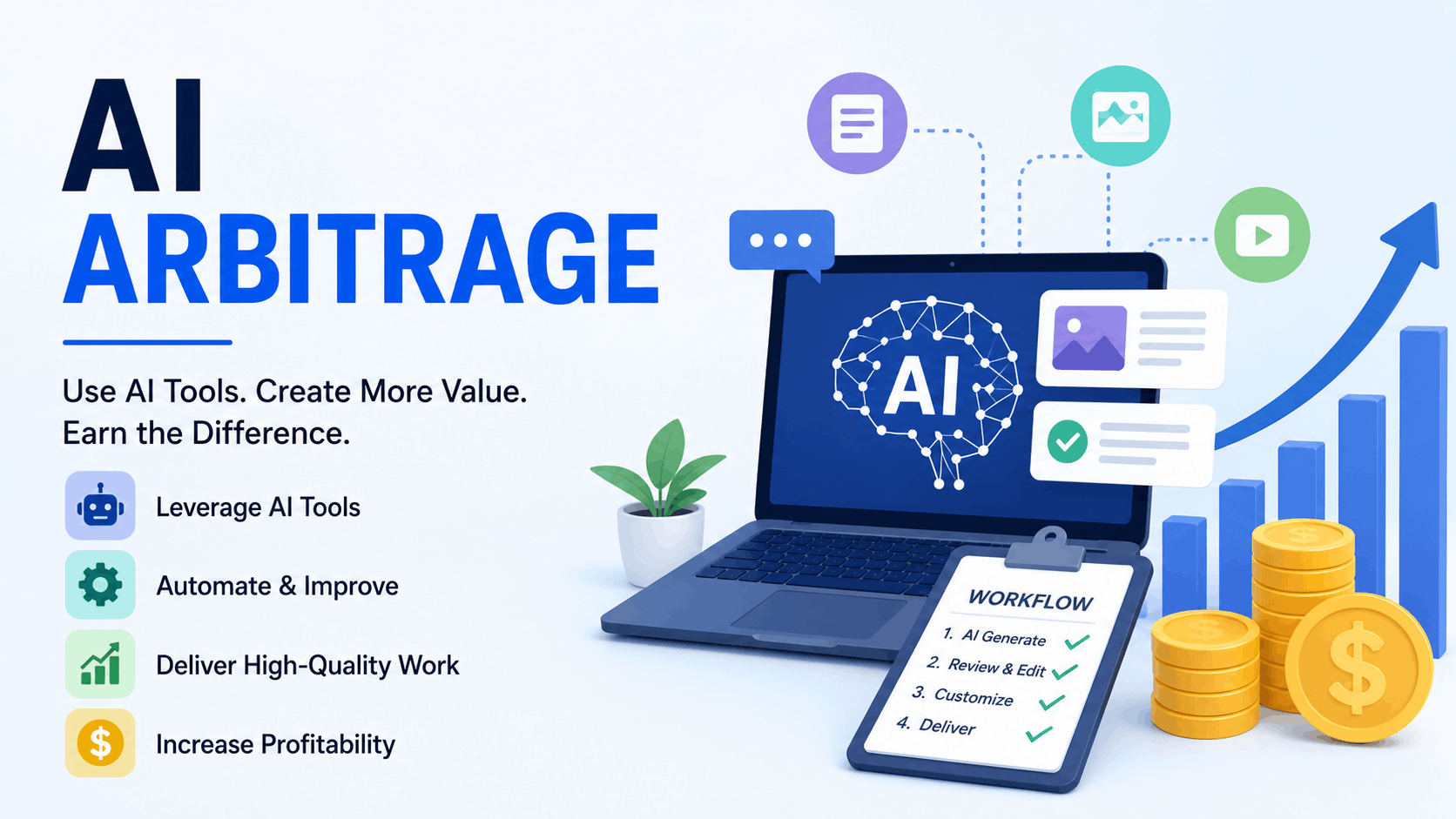

Artificial intelligence is changing the way people work, build businesses, and generate income. Among the newest opportunities gaining attention is AI arbitrage — a business model that combines AI tools with existing products or services to create additional value and profit.
Unlike traditional arbitrage, which focuses on buying low and selling high, AI arbitrage is about using artificial intelligence to perform work faster, more efficiently, or at a lower cost than conventional methods. Entrepreneurs, freelancers, agencies, and small business owners are increasingly using AI to automate tasks, improve productivity, and deliver services that would otherwise require much more time and resources.
Whether you’re interested in content creation, graphic design, marketing, software development, or customer support, AI arbitrage offers numerous opportunities to build scalable income streams with relatively low startup costs.
In this guide, you’ll learn what AI arbitrage is, how it works, its benefits, common business models, potential risks, and practical steps for getting started.
What Is AI Arbitrage?
AI arbitrage is the process of using artificial intelligence tools to create, improve, or automate products and services that are then sold at a higher value.
Instead of performing every task manually, businesses leverage AI to reduce production time while maintaining quality. The difference between the cost of using AI tools and the value customers are willing to pay creates the profit margin.
For example, a freelancer might use AI to draft articles, create marketing copy, design graphics, or generate reports before refining the output and delivering a polished final product to clients.
The value doesn’t come from simply using AI—it comes from combining AI efficiency with human expertise, editing, creativity, and customer service.
How Does AI Arbitrage Work?
The concept is relatively straightforward.
A person or business uses AI-powered software to complete tasks more efficiently than traditional methods. The finished work is then enhanced, customized, and delivered as a professional service or product.
A simple workflow often looks like this:
- Identify a service customers need.
- Use AI to speed up production.
- Review and improve the AI-generated output.
- Deliver a high-quality final product.
- Earn the difference between production costs and the selling price.
This model allows entrepreneurs to serve more clients without significantly increasing workload.
Types of AI Arbitrage
AI arbitrage can be applied across many industries and business models.
Content Creation
Writers and agencies use AI to:
- Draft blog posts
- Generate product descriptions
- Create social media content
- Write email campaigns
- Produce marketing copy
Human editing ensures accuracy, originality, and brand consistency before delivery.
Graphic Design
AI design tools can quickly generate:
- Logos
- Social media graphics
- Presentation visuals
- Advertising creatives
- Marketing banners
Designers often refine these assets to meet client requirements.
Video Production
AI-powered video tools can assist with:
- Script generation
- Voiceovers
- Automatic subtitles
- Video editing
- Short-form content creation
This significantly reduces production time.
Software Development
Developers increasingly use AI to:
- Generate code
- Debug applications
- Write documentation
- Create prototypes
- Automate repetitive programming tasks
This improves productivity while allowing developers to focus on more complex work.
Digital Marketing
Marketing agencies use AI for:
- Keyword research
- Content planning
- SEO optimization
- Ad copy creation
- Customer analysis
- Campaign reporting
AI helps deliver faster results while maintaining strategic oversight.
Benefits of AI Arbitrage
Businesses and freelancers are adopting AI arbitrage because it offers several advantages.
Lower Operating Costs
AI reduces the amount of manual work required, lowering production costs without sacrificing efficiency.
Increased Productivity
Tasks that once required several hours can often be completed in a fraction of the time, allowing professionals to handle more projects.
Scalability
Because AI automates repetitive work, businesses can expand operations without hiring large teams immediately.
Faster Turnaround Times
Clients appreciate quicker delivery, making AI-assisted businesses more competitive in many industries.
Higher Profit Potential
Efficient workflows often increase profit margins by reducing labor costs while maintaining service quality.
How to Start an AI Arbitrage Business
Starting an AI arbitrage business doesn’t require a large investment, but it does require a clear strategy and a focus on delivering real value. The goal isn’t simply to use AI—it’s to combine AI with your skills to solve problems for clients more efficiently.
Step 1: Choose a Niche
Begin by selecting a service that has consistent demand.
Popular AI arbitrage niches include:
- Content writing
- SEO services
- Graphic design
- Video editing
- Social media management
- Email marketing
- Website development
- Customer support
- Data analysis
- Virtual assistance
Focusing on one niche initially makes it easier to build expertise and attract your ideal clients.
Step 2: Select the Right AI Tools
Different tasks require different AI solutions.
For example:
| Task | AI Tool Type |
|---|---|
| Writing | AI writing assistants |
| Image creation | AI image generators |
| Video editing | AI video editors |
| Coding | AI coding assistants |
| Marketing | AI marketing platforms |
| Research | AI research tools |
Choose tools that improve your workflow while still allowing room for human review and customization.
Step 3: Develop Your Workflow
A structured workflow helps maintain quality and consistency.
A typical AI arbitrage process may look like this:
- Receive client requirements.
- Generate a draft using AI.
- Edit and fact-check the content.
- Customize it according to the client’s brand or goals.
- Perform quality assurance.
- Deliver the finished work.
Adding human expertise is what transforms AI-generated output into a professional service.
Step 4: Build a Portfolio
Before approaching clients, create several sample projects that demonstrate your capabilities.
Examples include:
- Blog articles
- Landing pages
- Logo designs
- Marketing campaigns
- Business reports
- Social media posts
A strong portfolio builds credibility and increases client confidence.
Step 5: Find Clients
There are many ways to attract customers.
Popular channels include:
- Freelance marketplaces
- LinkedIn networking
- Personal websites
- Cold email outreach
- Digital marketing
- Referrals
- Online communities
Consistency is often more important than using a single marketing strategy.
Popular AI Arbitrage Business Models
AI arbitrage isn’t limited to one type of business. Entrepreneurs are applying it in many different ways.
Freelancing
Offer AI-assisted services while providing human editing, strategy, and customer support.
Common services include:
- Content writing
- Copywriting
- SEO optimization
- Graphic design
- Video editing
Digital Agencies
Many agencies now use AI internally to complete projects faster while maintaining quality standards.
This allows them to serve more clients without significantly increasing operational costs.
Selling Digital Products
AI can help create products such as:
- Templates
- E-books
- Online courses
- Prompt libraries
- Business resources
- Printable planners
These products can generate recurring income after the initial creation process.
Consulting
Businesses often need guidance on implementing AI effectively.
Consultants help organizations:
- Select AI tools
- Improve workflows
- Automate repetitive tasks
- Train employees
- Develop AI strategies
Benefits of AI Arbitrage
When implemented responsibly, AI arbitrage offers several advantages.
Lower Startup Costs
Many AI tools operate on affordable monthly subscriptions, allowing entrepreneurs to launch businesses without significant upfront investment.
Faster Project Delivery
AI automates repetitive tasks, helping professionals complete projects more quickly while maintaining quality through careful review.
Increased Productivity
Instead of replacing human expertise, AI allows professionals to spend more time on strategy, creativity, and client communication.
Better Scalability
As demand grows, businesses can often handle more work without increasing staff at the same pace.
Competitive Advantage
Companies that combine AI efficiency with high-quality human oversight may be able to deliver better value and faster turnaround times than competitors relying solely on manual processes.
Challenges and Risks
While AI arbitrage has exciting opportunities, it also comes with responsibilities and potential challenges.
Quality Control
AI-generated content isn’t always accurate or complete.
Every project should be carefully reviewed, edited, and fact-checked before delivery.
Copyright and Licensing
Always ensure that any AI-generated content, images, or code complies with the licensing terms of the tools being used and respects intellectual property rights.
Client Transparency
Some clients may want to know whether AI was used during production.
Being transparent about your workflow can help build trust and establish long-term relationships.
Rapid Technology Changes
AI tools evolve quickly.
Staying informed about new features and industry trends is essential for remaining competitive.
Common Mistakes to Avoid
Many beginners make avoidable mistakes when starting an AI arbitrage business.
Relying Entirely on AI
AI should support your work—not replace your expertise.
Human editing, creativity, and strategic thinking remain essential.
Ignoring Client Needs
Generating fast content is meaningless if it doesn’t solve the client’s problem.
Always prioritize customer goals over speed.
Choosing Too Many Niches
Trying to offer every AI service can dilute your expertise.
Starting with one niche allows you to build authority and refine your workflow.
Skipping Quality Checks
Never deliver AI-generated work without reviewing it for accuracy, clarity, and originality.
A strong quality assurance process protects your reputation and improves client satisfaction.
FAQs
What is AI arbitrage?
AI arbitrage is a business model that uses artificial intelligence tools to create, improve, or automate products and services more efficiently. Entrepreneurs then sell these enhanced services or products for a profit by combining AI with human expertise.
Is AI arbitrage legal?
Yes. Using AI tools for business purposes is generally legal as long as you comply with the software’s licensing terms, respect copyright laws, protect customer data, and avoid misleading clients about your services.
Do I need technical skills to start AI arbitrage?
Not necessarily. Many AI tools are designed for beginners and require little to no coding knowledge. However, having skills in writing, design, marketing, programming, or business management can help you deliver higher-quality results.
How much does it cost to start?
The startup cost depends on the tools you choose and the services you offer. Many AI platforms provide free plans or affordable monthly subscriptions, making AI arbitrage accessible for freelancers, small businesses, and startups.
Can AI arbitrage become a full-time business?
Yes. Many entrepreneurs have built successful businesses by combining AI with professional services. Long-term success depends on consistently delivering quality work, building client relationships, and adapting to new AI technologies.
Which industries benefit most from AI arbitrage?
AI arbitrage can be applied across a wide range of industries, including:
- Digital marketing
- Content creation
- Graphic design
- Software development
- E-commerce
- Customer support
- Education
- Finance
- Real estate
- Business consulting
As AI capabilities continue to expand, new opportunities are emerging in almost every sector.
Is AI-generated content enough on its own?
No. While AI can significantly speed up production, human review is essential for ensuring accuracy, originality, creativity, and alignment with a client’s goals. The most successful AI arbitrage businesses combine automation with professional expertise.
Best Practices for Success
Building a sustainable AI arbitrage business requires more than simply using AI tools. Following these best practices can help you stand out in a competitive market.
Focus on Delivering Value
Clients are paying for solutions, not just AI-generated output. Use AI to improve efficiency while ensuring the final product meets professional standards.
Keep Learning
Artificial intelligence evolves rapidly. Regularly explore new tools, features, and workflows to stay ahead of competitors and expand your service offerings.
Build Strong Client Relationships
Excellent communication, reliable delivery, and consistent quality are key to earning repeat business and referrals.
Protect Sensitive Information
If you’re handling client data, use secure platforms and follow appropriate privacy practices. Responsible data management helps build trust and protects your reputation.
Develop Repeatable Systems
Create standard operating procedures (SOPs) for research, production, editing, quality checks, and delivery. Well-documented workflows improve consistency and make it easier to scale your business.
The Future of AI Arbitrage
AI technology continues to improve at an incredible pace, and its role in business is expected to grow even further.
Future trends may include:
- More advanced AI assistants
- Better automation of repetitive tasks
- Improved content generation quality
- AI-powered customer service
- Smarter business analytics
- Faster software development
- Personalized marketing at scale
- Greater collaboration between humans and AI
Rather than replacing skilled professionals, AI is likely to become an essential productivity tool that helps businesses work more efficiently and innovate faster.
Conclusion
AI arbitrage is creating new opportunities for entrepreneurs, freelancers, agencies, and businesses to deliver high-quality services more efficiently. By combining artificial intelligence with human creativity, expertise, and quality control, professionals can reduce production time, improve scalability, and increase profitability without compromising value.
Whether you’re offering content writing, graphic design, marketing, software development, or consulting services, AI can help streamline repetitive tasks while allowing you to focus on strategy and customer relationships. The key to success is using AI responsibly—reviewing every output, maintaining transparency where appropriate, and continuously improving your skills as technology evolves.
As artificial intelligence becomes an increasingly important part of the modern workplace, AI arbitrage is likely to remain a valuable business model for those willing to adapt. By choosing the right niche, building efficient workflows, and consistently delivering exceptional results, you can position yourself for long-term success in the growing AI-powered economy.